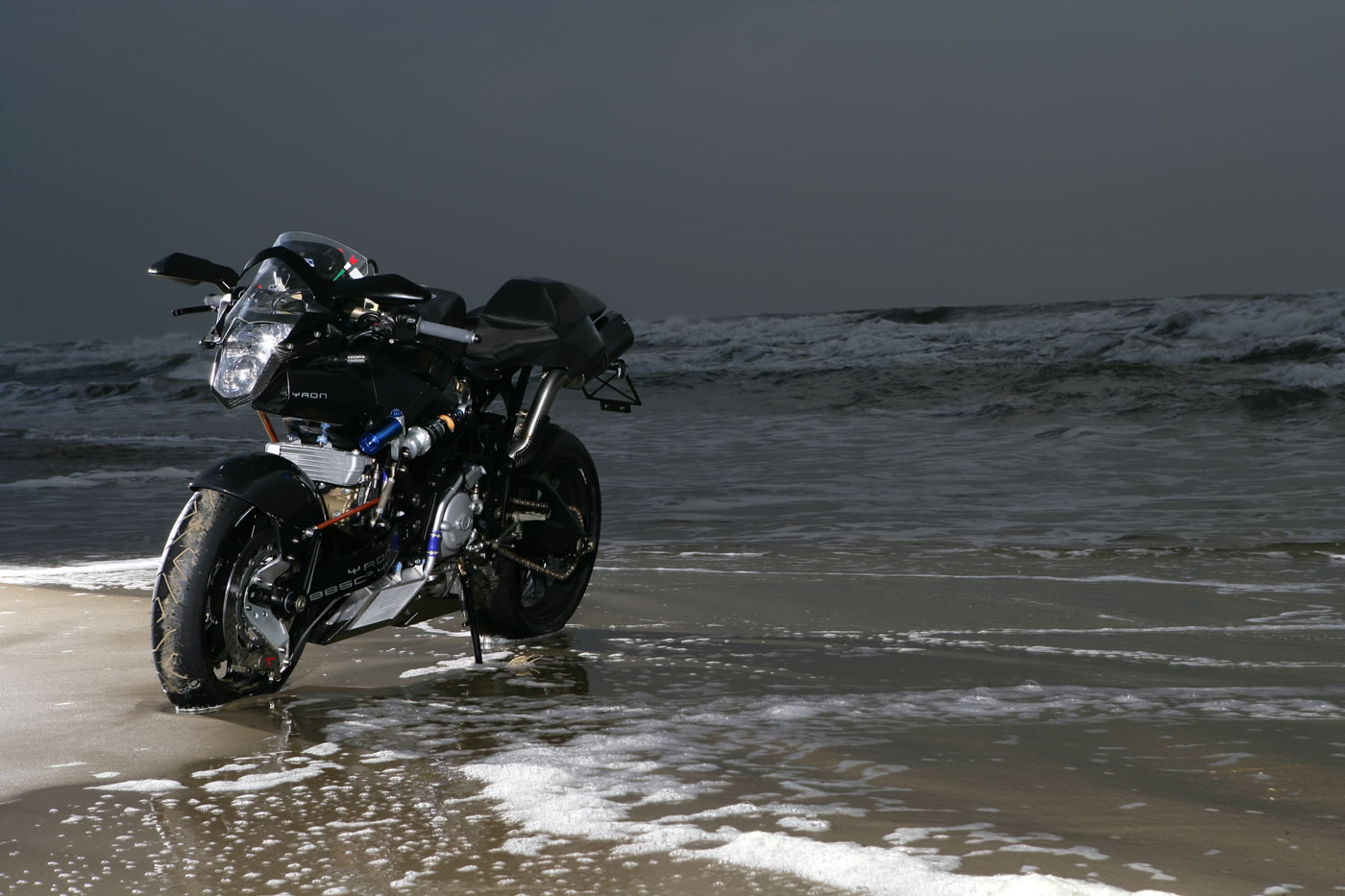
"Look around here," says Ascanio Rodorigo with a
laconic wave of his right hand at the glorious array of
priceless motorcycles inside the Barber Vintage
Motorsports Museum. "Any of these bikes made in the past
50 years have all been built the same way, with the same
design and the same faults. It's our objective to try to
persuade people to take a fresh look at two-wheeled
chassis design. Questa e la mia sfida--this is my
challenge."
Rodorigo, 43, began working for Massimo Tamburini at
Bimota back in 1983-'84, before Cagiva boss Claudio
Castiglioni lured away the "ta" in the company name to
create such works of art as the iconically beautiful
Ducati 916 and MV Agusta F4. But if his former boss is
the Michelangelo of motorcycles, Rodorigo is the Picasso,
as one look at his latest example of deconstructed cubist
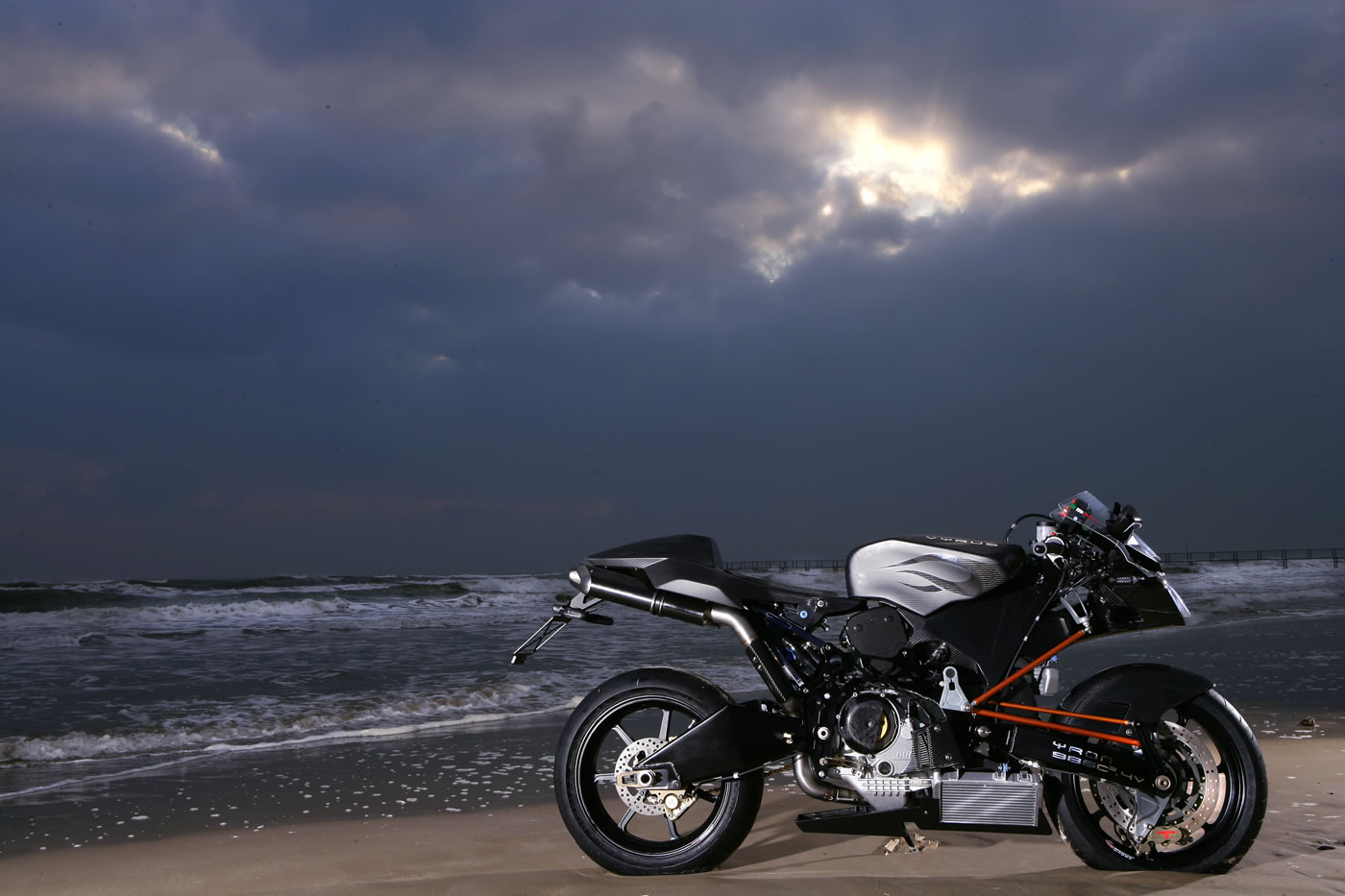
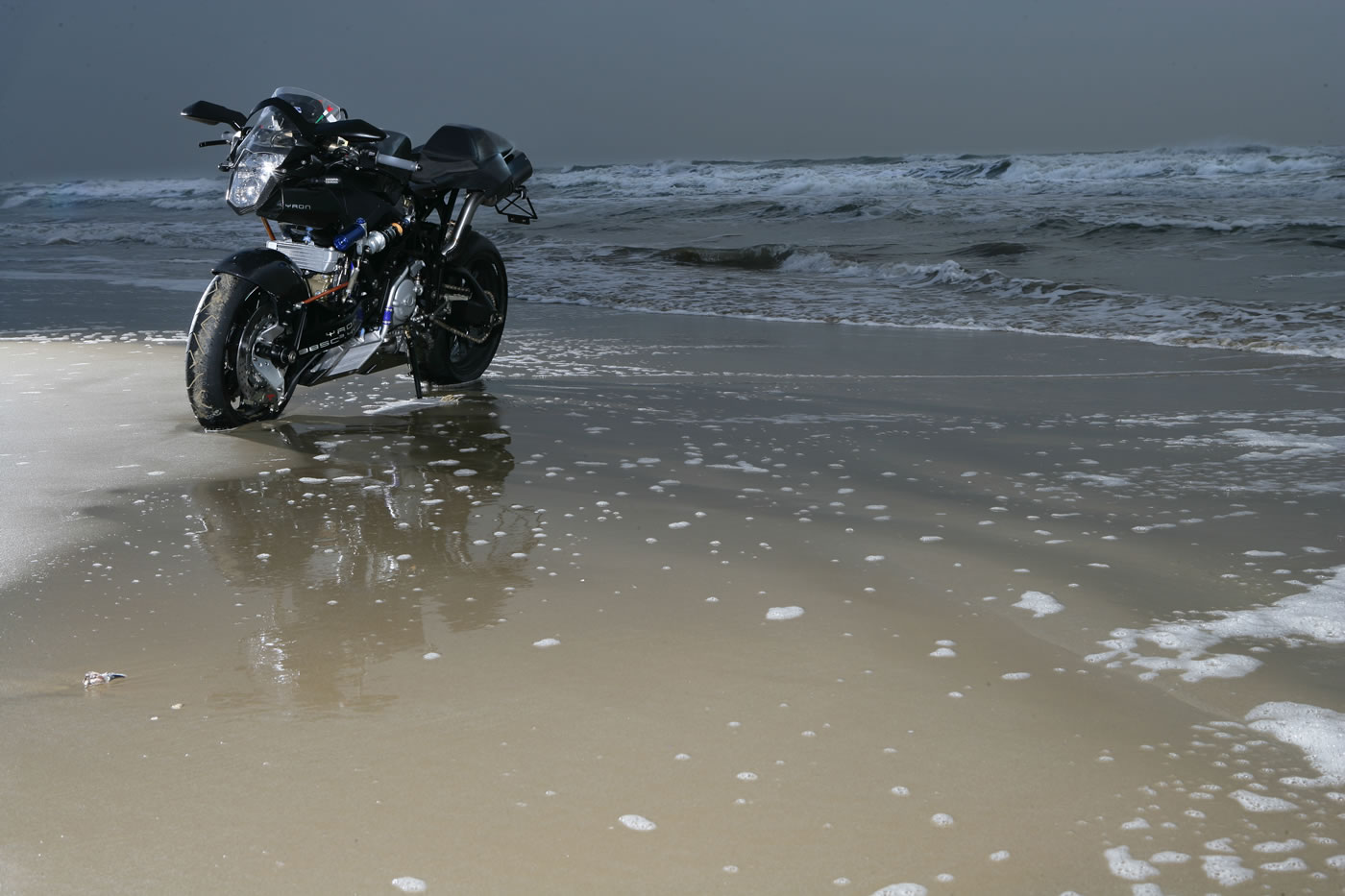
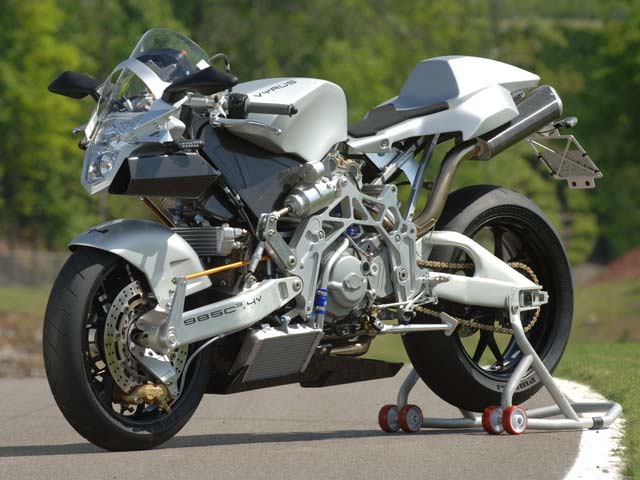
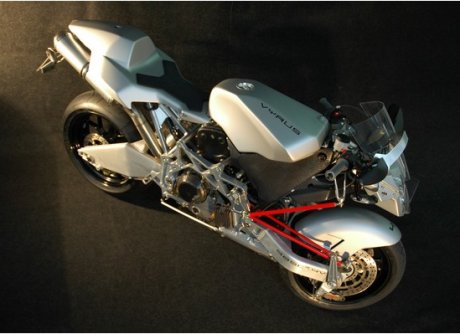
two-wheeled sculpture, the Vyrus 985 C3 4V, will confirm.
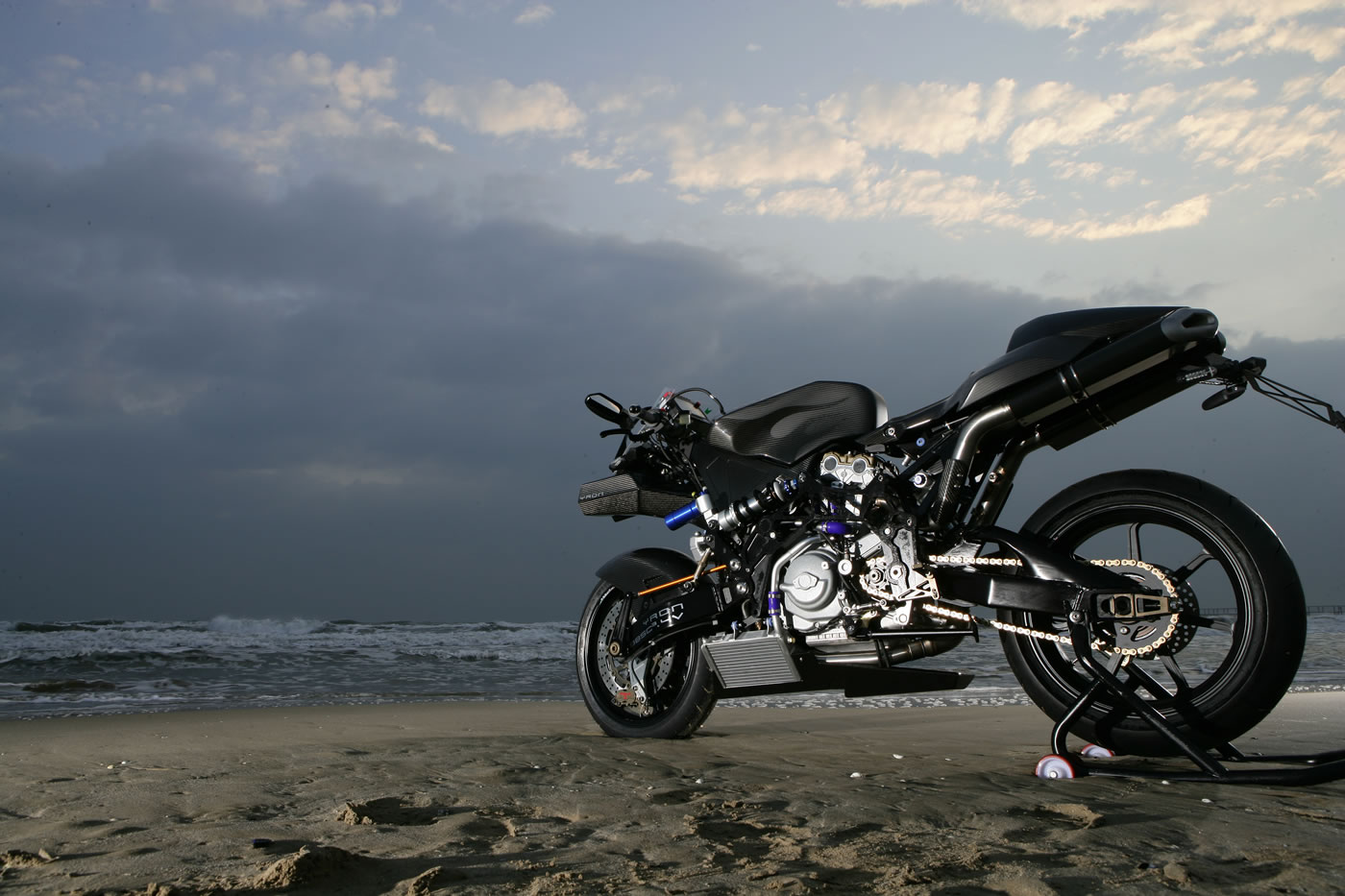
Like the Richard Rogers-designed Pompidou Art Center in
Paris, which displays its pipes, drains, conduits and
heating ducts on the exterior of its walls for all to see,
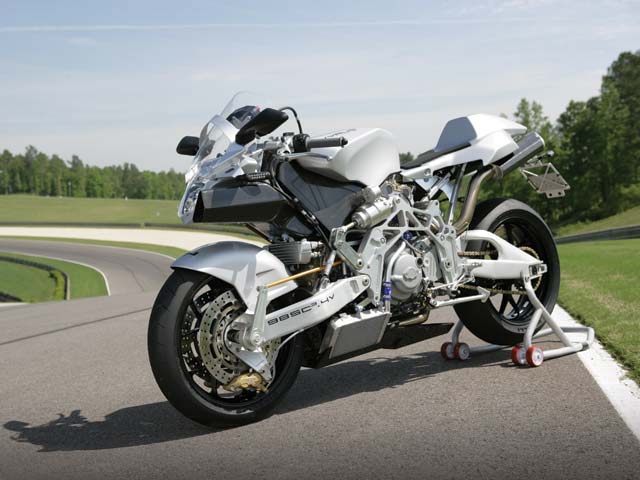
the surreal Vyrus wears its technology on the outside. As
the 21st-century evoluzione version of the avant-garde
Tesi 1D streetbike that Bimota built from 1991-'93, the
Vyrus is a technological tour de force that is even more
minimalist and aesthetically appealing than the
slab-sided Tesi.
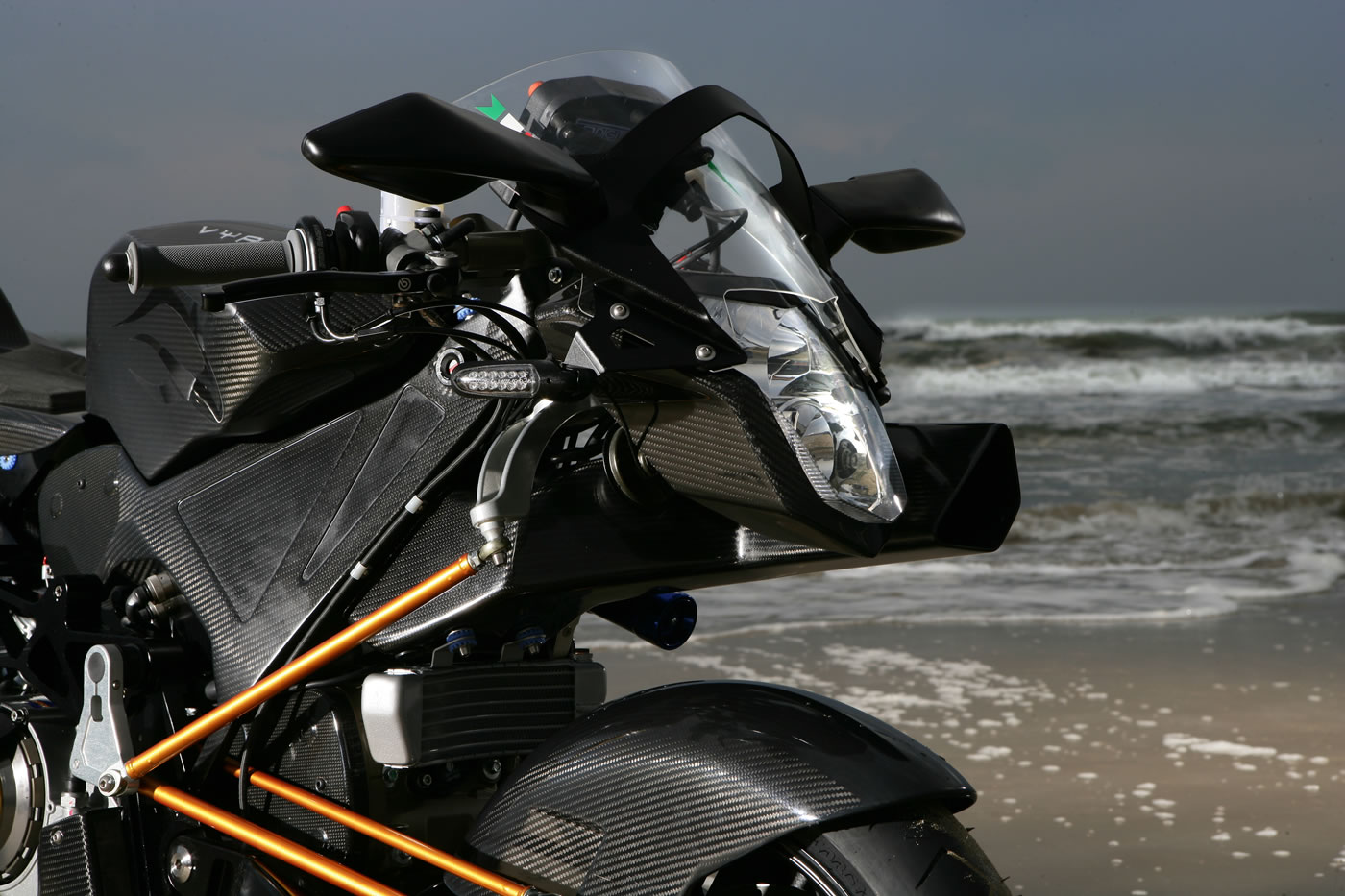
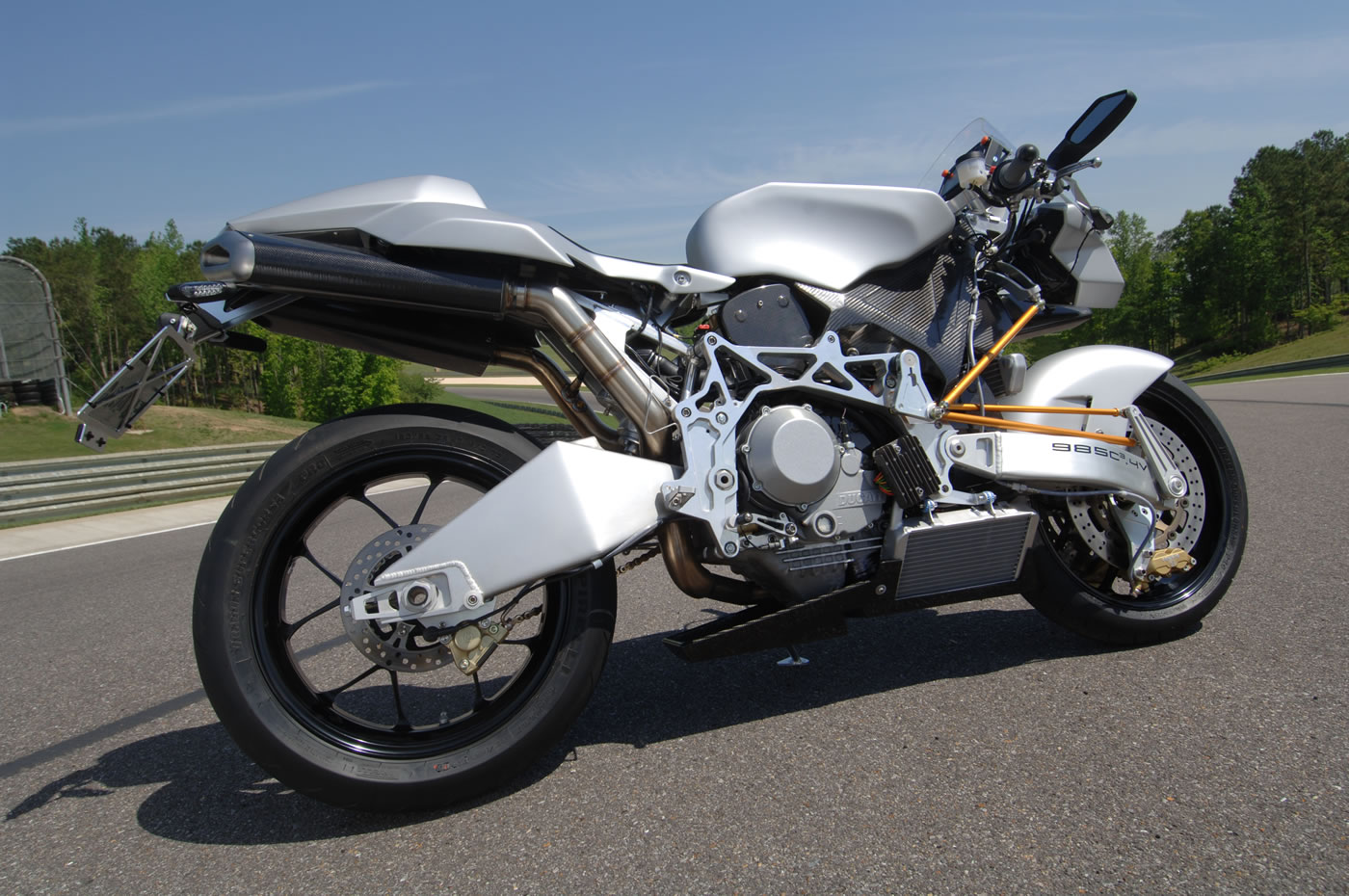
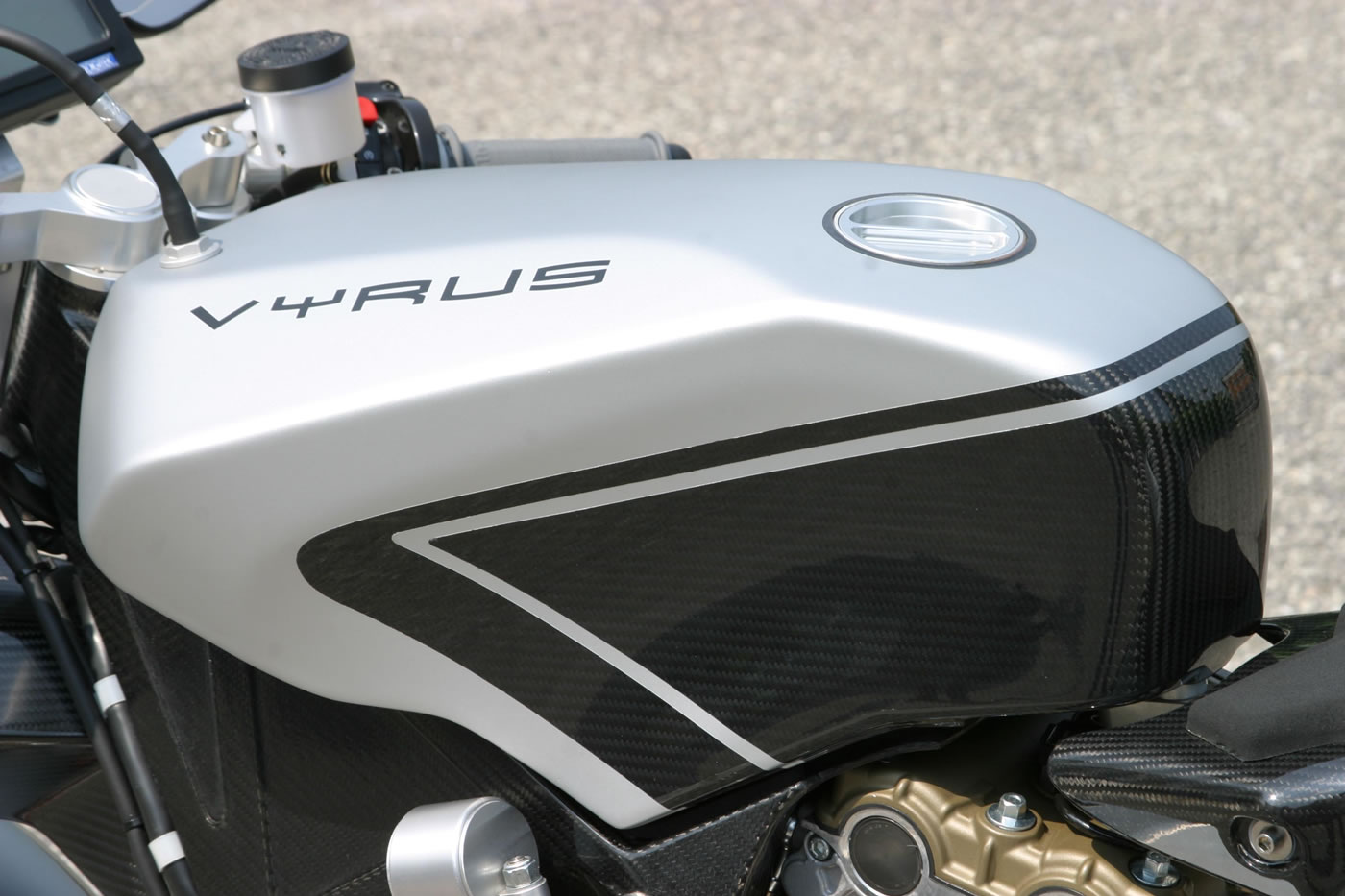
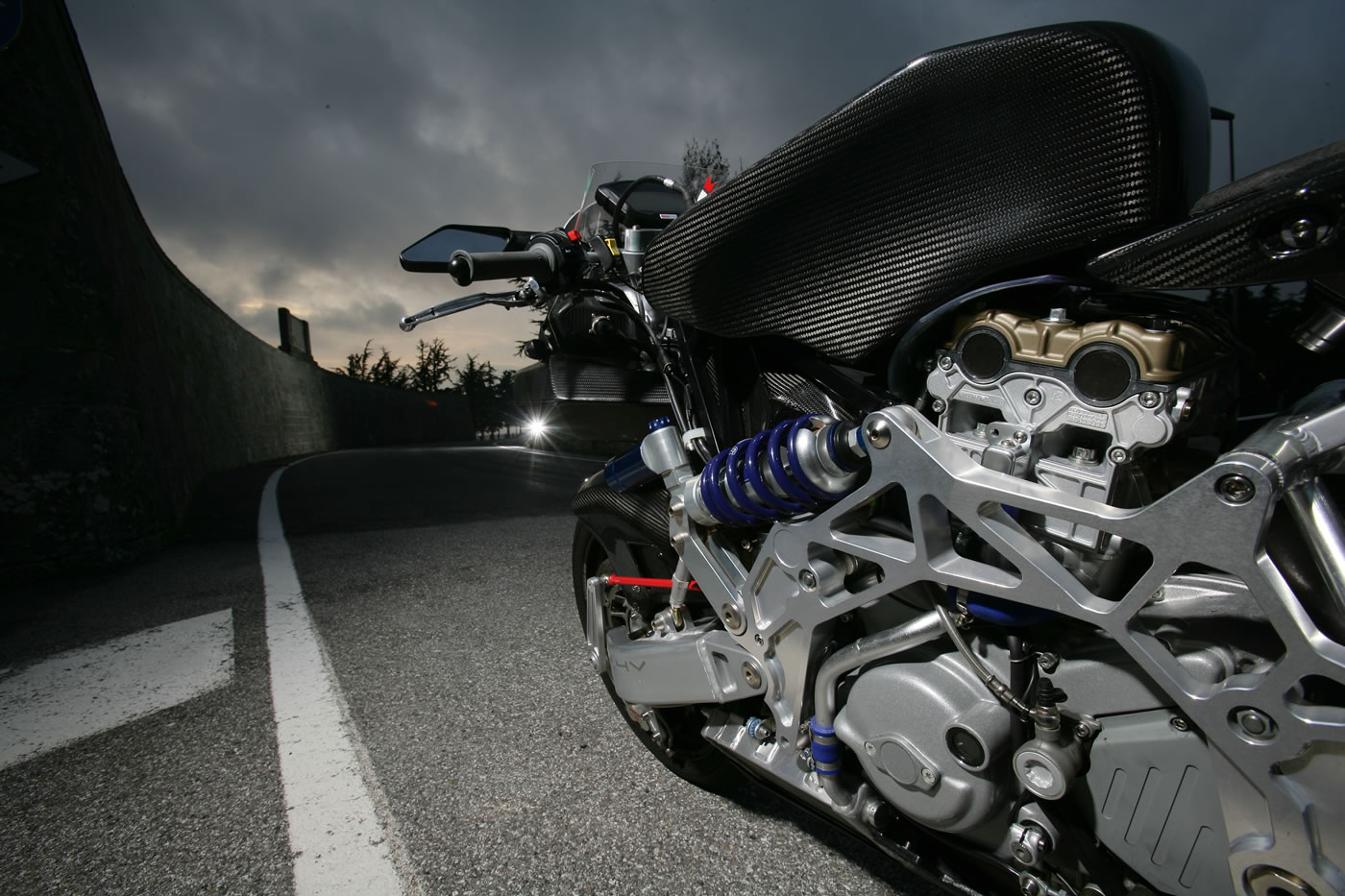
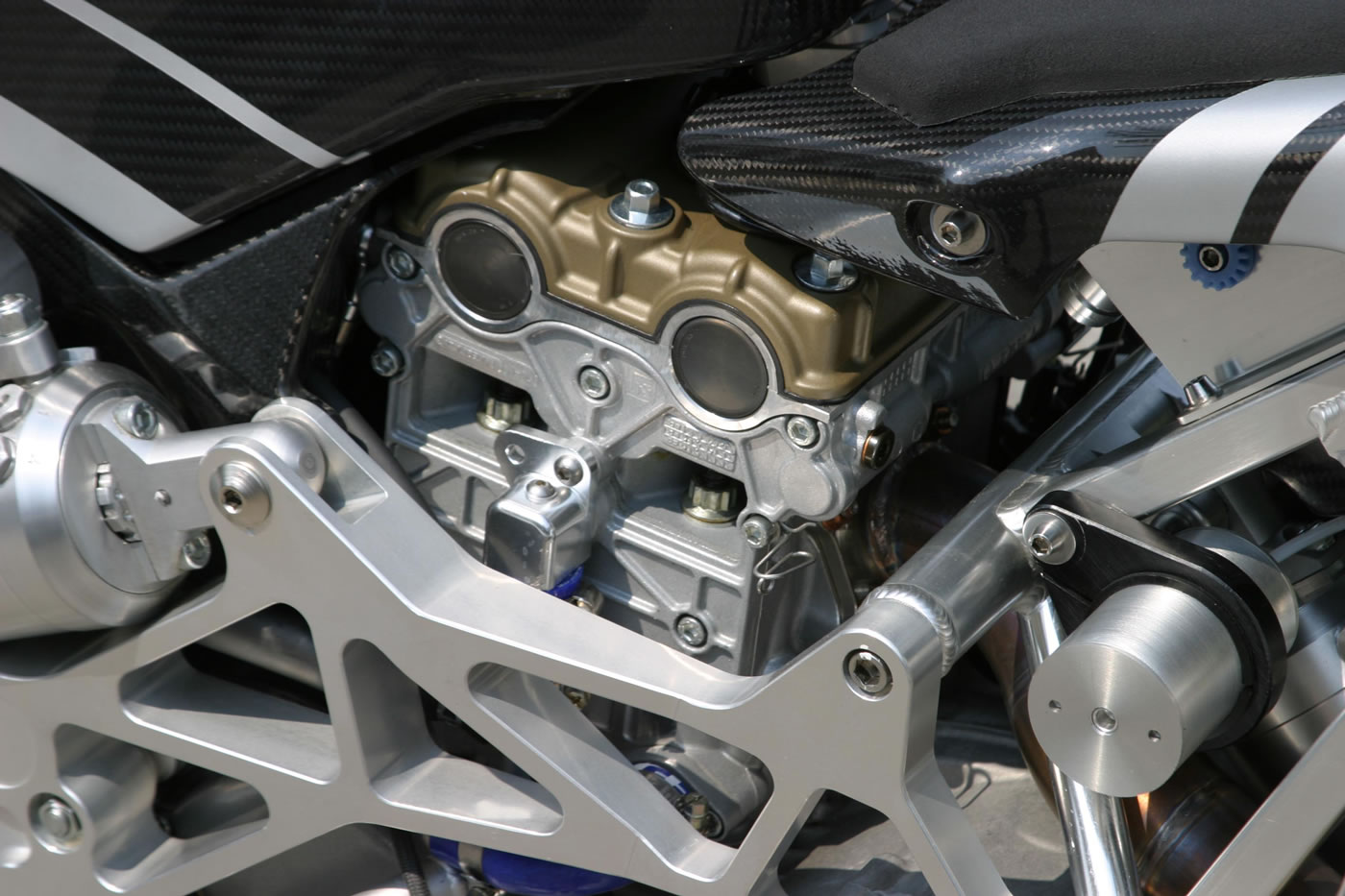
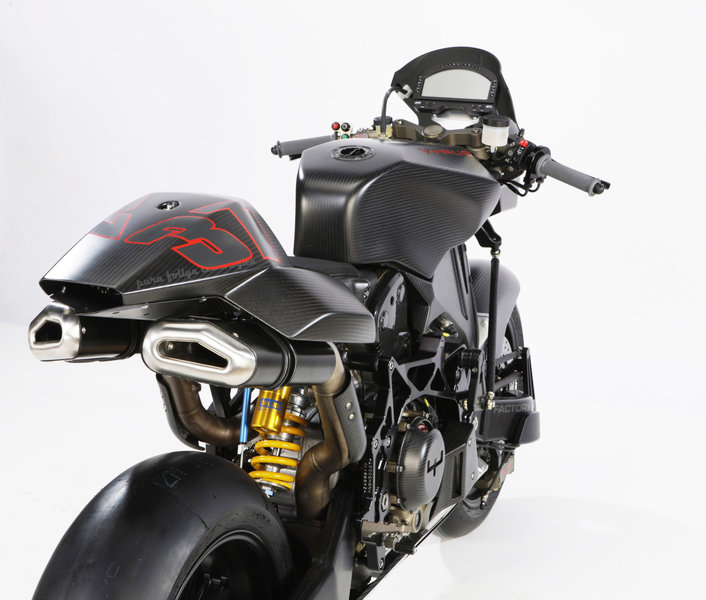
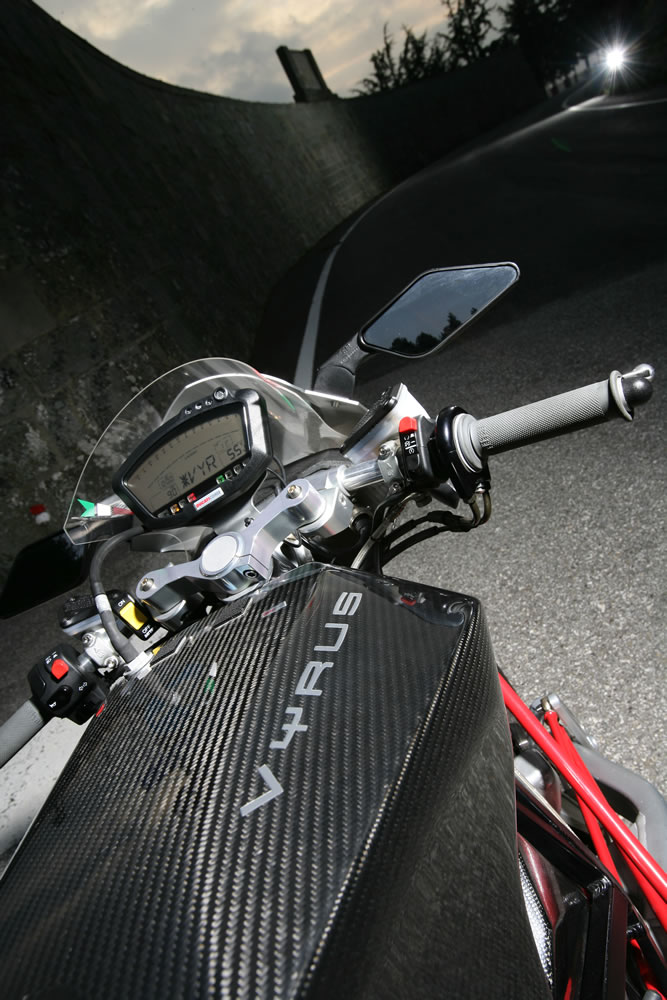
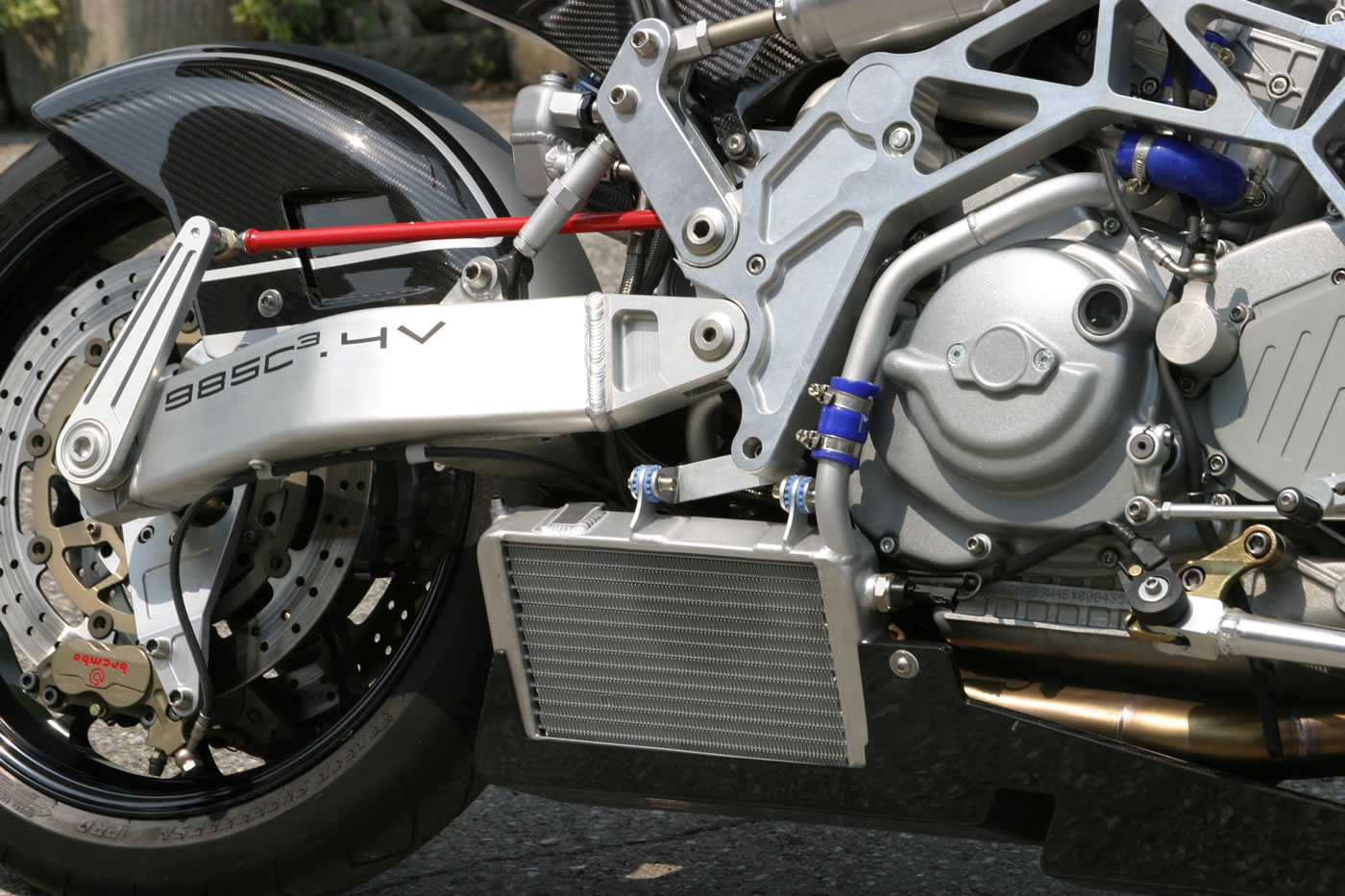
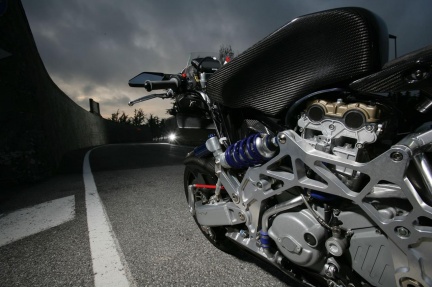
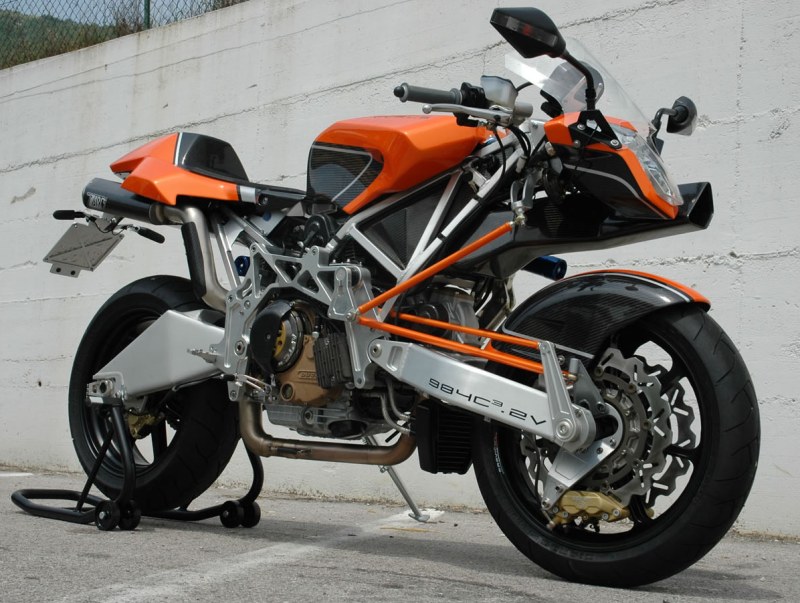
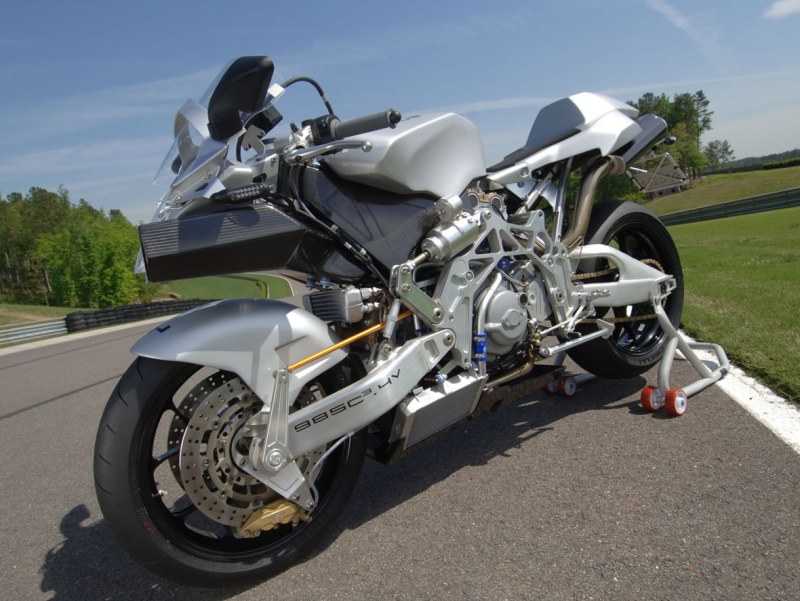
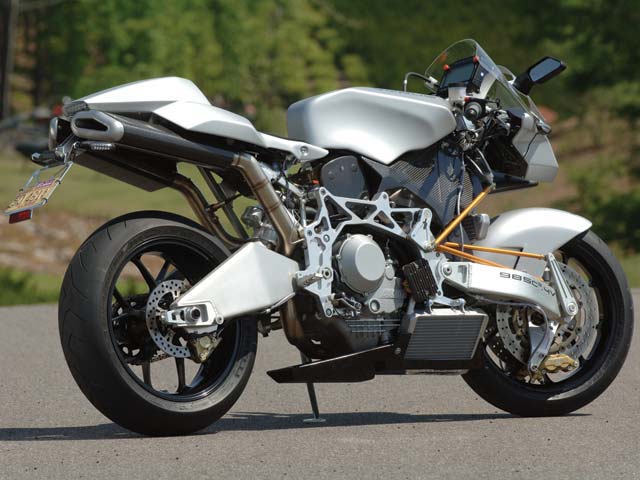
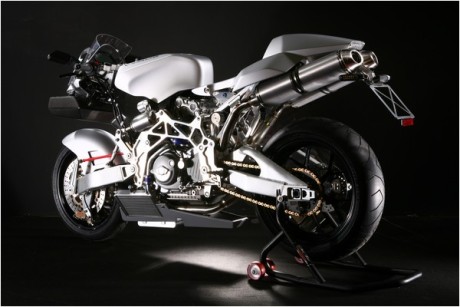
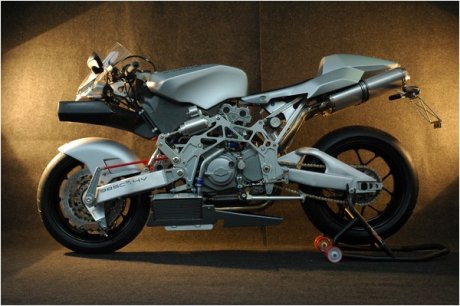
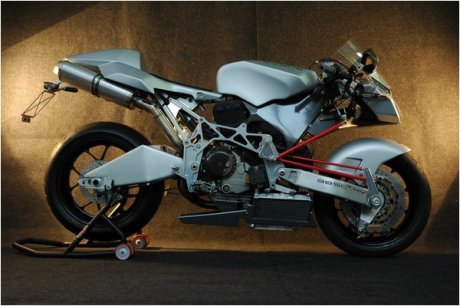
Gaze closely at the Vyrus and every 10 seconds yields
another trick part or artistic feature--the gold-anodized
track rods operating the car-type hub-center steering, or
the skeletal CNC-machined aluminum frame spars, the
stress paths of which were carefully plotted by finite
element analysis, then the metal around them removed to
save crucial ounces. Or the heavily revised steering
linkage with the bell crank positioned on the front of
the right frame spar, and the gently curved alloy drag
link operating the rod that activates it, helping to
eliminate some of the copious change in direction the
original Tesi design incorporated, and restoring some of
the filtered-out road feel. Or ... you get the picture.
This is an exquisitely conceived, finely detailed and
brilliantly executed motorcycle, a genuine work of modern
art.
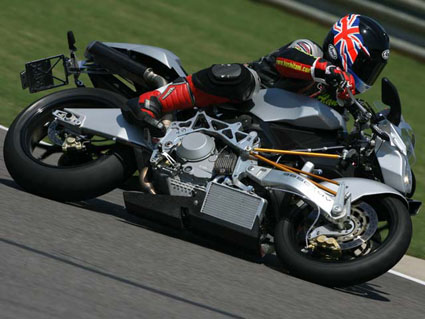
Taking to the Barber racetrack aboard the Vyrus was,
for me, a two-hour trip down memory lane. What memories?
Why travel all the way from England to Birmingham,
Alabama, to ride a motorcycle hand-crafted in Rimini,
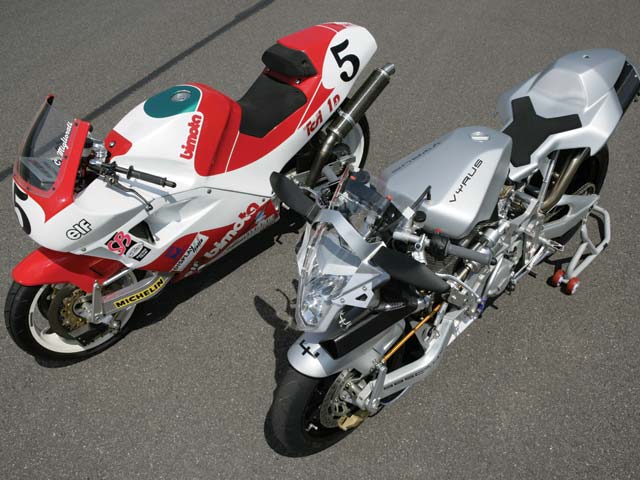
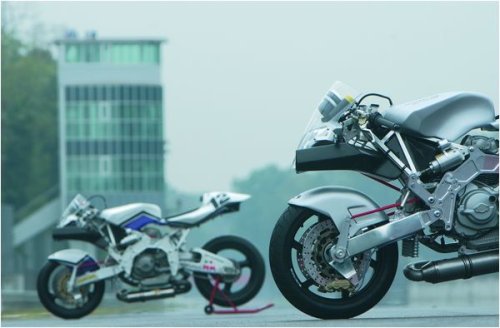
Italy? Because the museum holds the original works Tesi
1D Superbike I raced for the Bimota factory in '91 and
'92. "My" bike may now be decorated in the colors of
Cristiano Migliorati, who raced it for a season in the
Italian National Superbike Championship after I was
through with it. But the chance to compare and contrast
two such radical examples of alternative thought was too
good to miss--especially as this particular Vyrus was
destined to find a home in the U.S.
Hopping aboard the Tesi brought the memories flooding
back, and underlined just how much smaller and more
purposeful the Vyrus is. Its riding position is
comfortable and comparatively normal, without your hands
being too close together as on some other hub-center
bikes due to there being no fork or triple-clamp assembly.
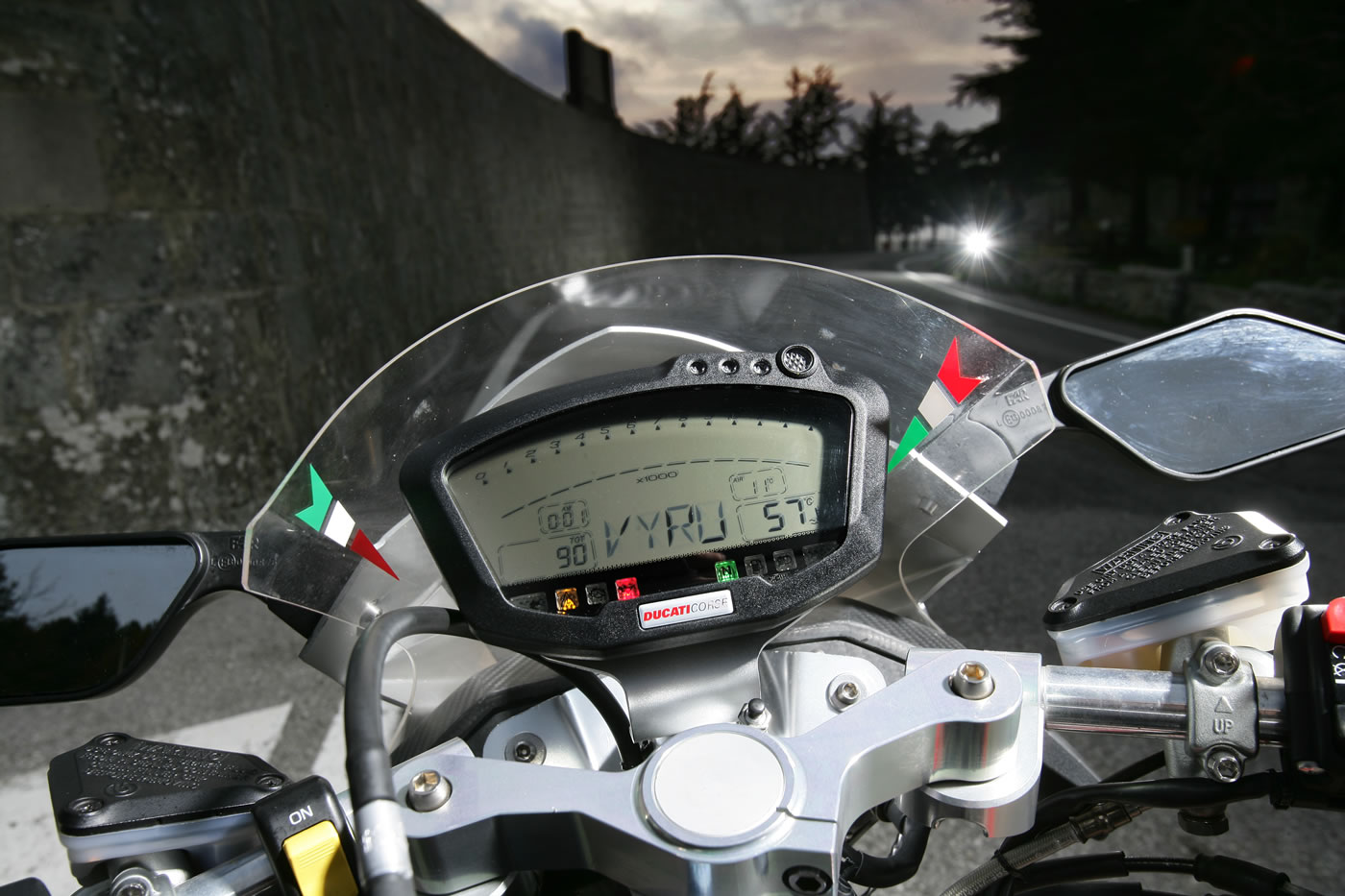
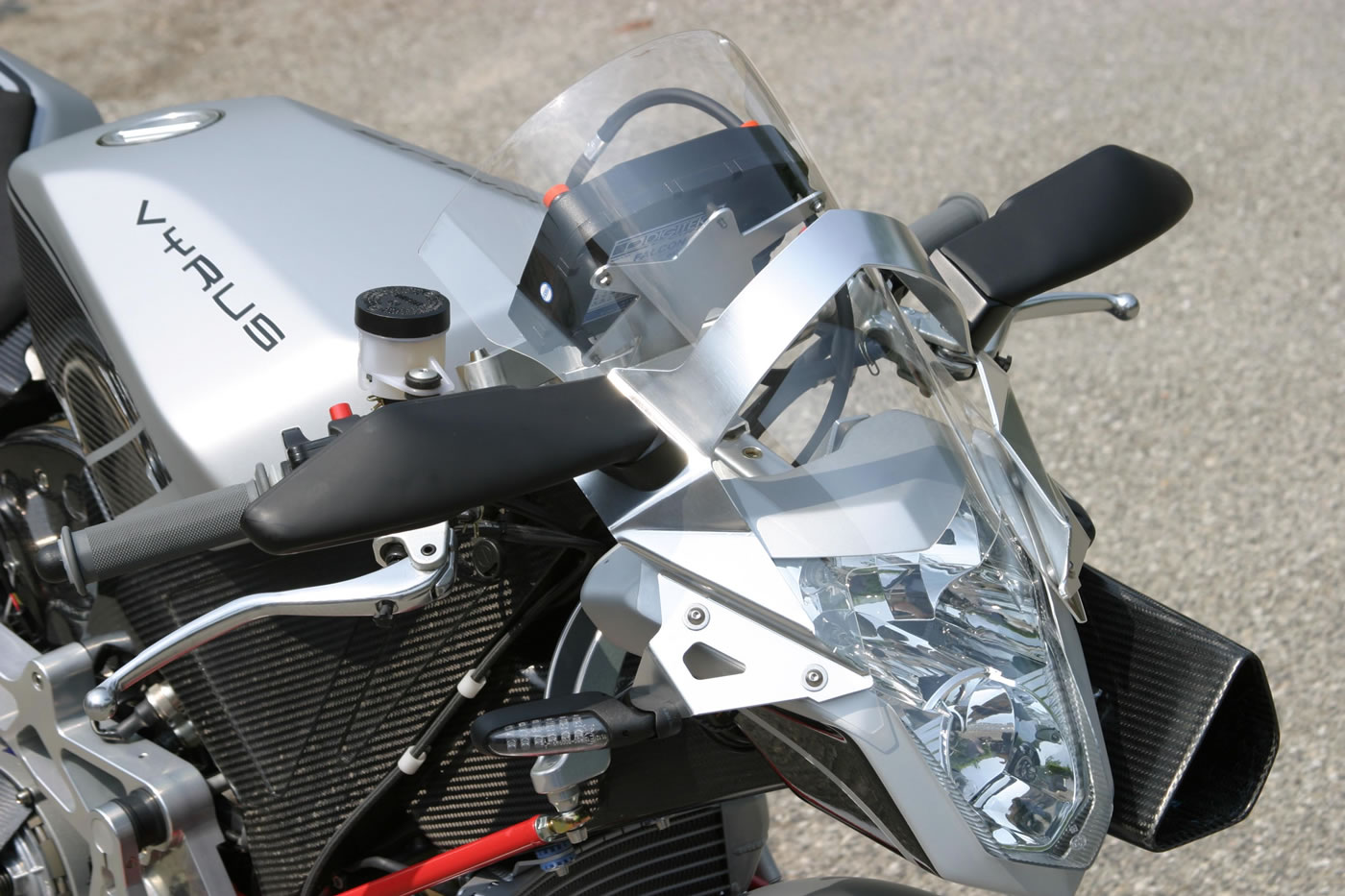
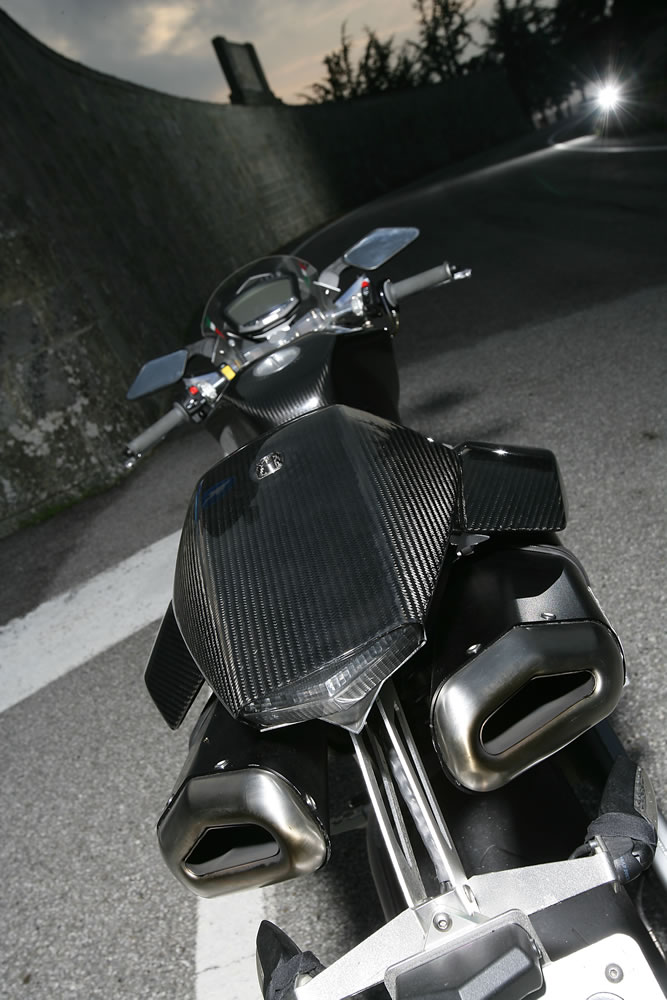
The absence of any bodywork other than the intricately
designed headlamp fairing adds to the sense of minimalism,
but not at the expense of adequate wind protection at the
140 mph achieved down Barber's short straights.

Though based on the Bimota Tesi, the Vyrus is built by
a separate entity and there are at present no plans to
import it to America. The company does, however, also
build a two-valve version that is being sold through
Bimota's dealer network as the Tesi 2D.
Everything about the Vyrus seems refined, even
delicate, and at first I struggled to reprogram my senses.
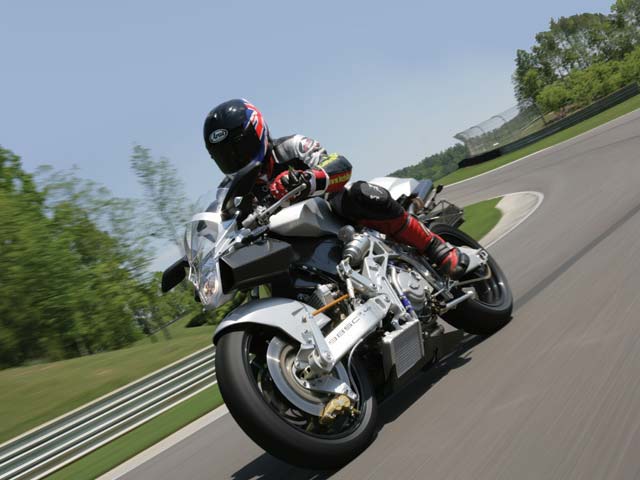
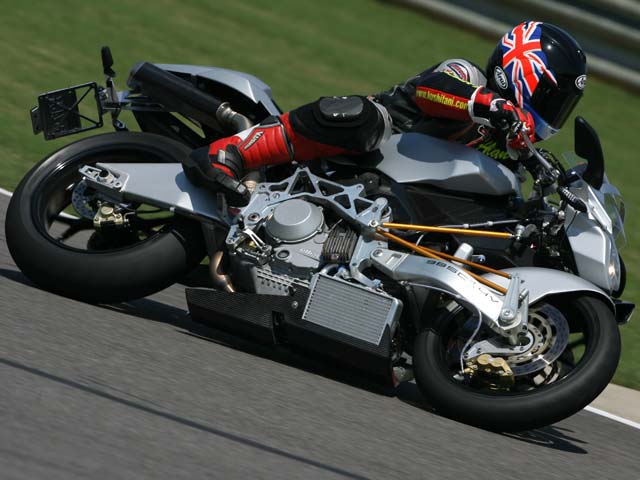
But after a handful of laps gradually picking up speed,
it suddenly clicked--and I remembered the mindset you
must adopt to get the best out of a hub-center motorcycle:
Hold the bars lightly and stay off the brakes until what
seems suicidally late. The separation of steering from
suspension is the biggest asset of such a front end.
There's essentially no dive, and the suspension eats up
bumps even when you're leaned over on the brakes. This
bike is so confidence-inspiring and well balanced there
seems no limit to how hard you can push it in corners.
Well, there is one: Such treatment wears out the stock
Pirelli Dragon Supercorsas very quickly. After around 50
laps, the front tire was well worn and the rear not much
better.
Stability and ride quality are surprisingly good for a
sportbike. The springless Double System air shocks are
well set up in their standard settings, and are for sure
more compliant than the stiffly sprung hlins we had to
run to stop my Tesi racebike from weaving at speed. The
Vyrus is easily flicked side to side, whereas the Tesi
was hard work at speed. The radical steering geometry,
with an 18-degree effective head angle and 3.8 inches of
trail (adjustable 6 degrees upward from there, and from
3.1 to 4.1 in. of trail), allowed it to change direction
faster than most bikes of comparable size. Yet that steep
head angle hasn't resulted in significant instability,
beyond one brief flick of the front wheel when I hit the
only real bump on the otherwise billiard-table-smooth
Barber surface accelerating out of the left horseshoe
leading onto the back straight.

The Vyrus' dramatic styling is the work of company
owner Ascanio Rodorigo with help from Sam Matthews,
formerly Pierre Terblanche's right hand man at Ducati,
now working for Citroen in Paris. "We did this at
long distance, with Sam making CAD drawings and me
interpreting them into a full-size clay model, then
e-mailing him photos of the result," Rodorigo
explains.
OK, so how did Rodorigo and company succeed in
reinventing the Tesi? "In fact, we started again with a
clean sheet of paper," he replies, "and decided we must
completely forget all our experience of standard
motorcycles, and think only of the suggestions offered
by Bimota in arriving at the best solution. We made a
bike that is a very stiff structure, where nothing
moves except the suspension and the tires. And we
produced a steering linkage with fewer bearings, so as
to give it more sensitivity. You must feel the front
tire as if the front axle were in your hands."
They also changed the center of gravity, raising the
engine 40mm (1.6 in.) higher than on a 999R and 50mm
(2.0 in.) higher than on the original Tesi. Weight
distribution was also an important factor. At rest, the
Vyrus has a 53 percent/47 percent forward weight bias,
but with a 150-pound rider aboard it's 50/50--perfectly
balanced.
"All this influences handling and makes the bike
steer much faster, especially with the short wheelbase,"
Rodorigo continues. "It's like a 250cc GP bike in terms
of geometry, but it's also completely stable in a
straight line. Even if you try to make it shake by
moving the handlebars, you can't. And we have no
steering damper fitted; that's a Band-Aid for a wrong
design!"
The only real downside to my reacquaintance with the
Tesi concept in Vyrus guise was the bike literally
hadn't run before being shipped to the U.S. As a result,
the 999R motor wasn't dialed-in, and needed a series of
stops to remap and retest before we got it running
somewhere close to OK. Rodorigo and his crew normally
do this before delivering a bike--the Misano racetrack
is just a stone's throw from their shop--but getting
the bike crated for its overseas voyage prevented them
from doing so this time. The problem is Ducati won't
authorize Magneti Marelli to release the access codes
for the stock 999R EFI, which would enable Vyrus to
remap the engine-management system for the much larger
airbox and asymmetric exhaust system. Hence the need to
fit an all-new ECU, the work of a small electronic
specialist in northern Italy called Microtec, which
seems to have done a good job.
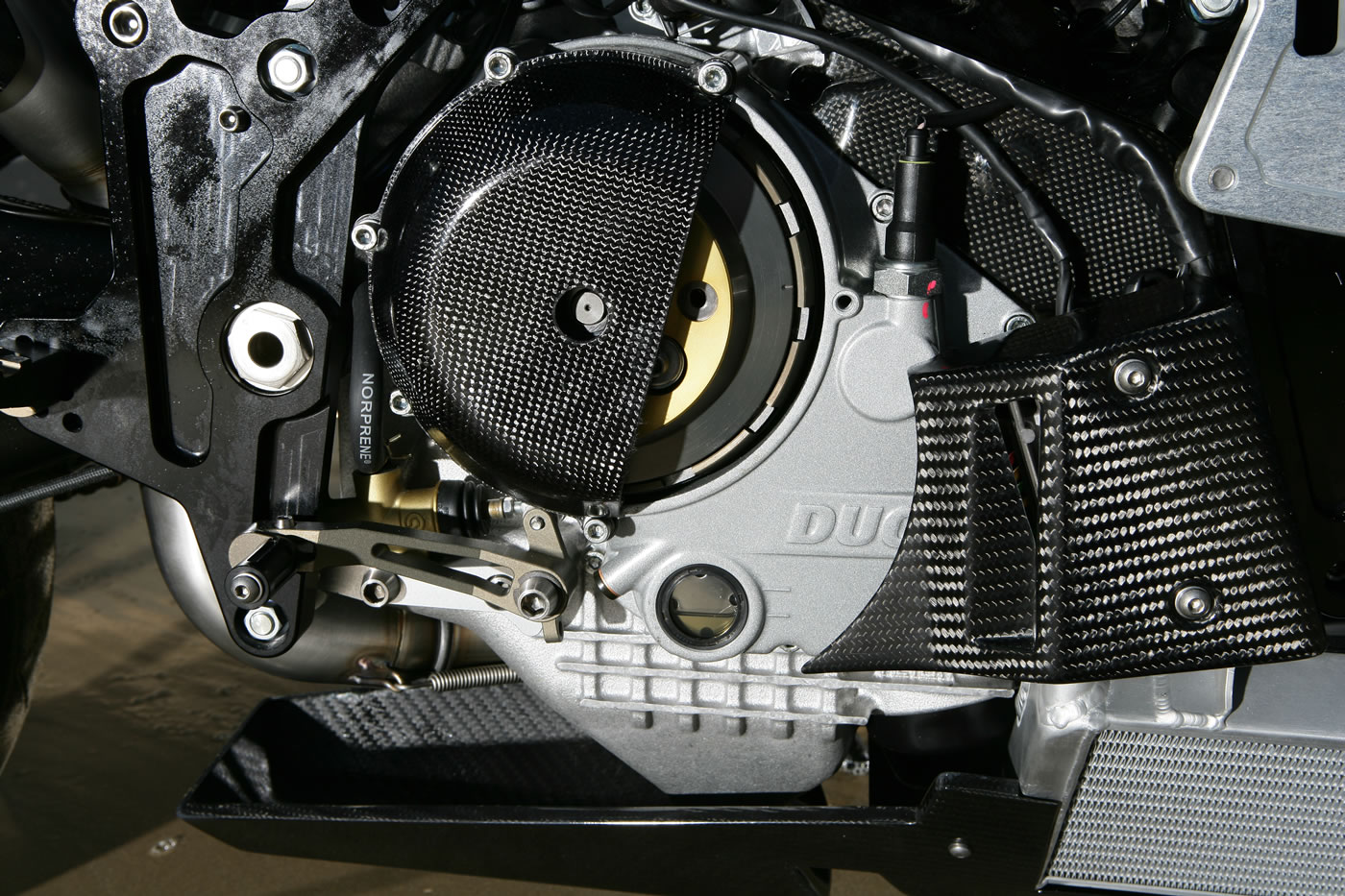
Once we got it dialed I could ride the meaty torque
curve of the short-stroke desmo V-twin and use its
appetite for revs to hold a gear, shifting just six
times per lap. Nice. With a claimed dry weight of 345
pounds and a reputed 150 rear-wheel horsepower at
10,500 rpm, the Vyrus is pretty invigorating to ride,
with zestful acceleration and no real vibration from
the engine even at five-figure revs, in spite of its
application as a totally integrated chassis component.
For many proponents of two-wheeled alternative
thought, the issue of finding a better way to hang a
bike's steering wheel has been a matter of debate ever
since BMW gave us the first telescopic fork almost 70
years ago. Apart from the brave-but-ultimately
unsuccessful 1993-'94 Yamaha GTS1000 with its James
Parker-developed RADD front end, it's been a
regrettable fact of commercial life that no major
manufacturer--except, inevitably, BMW--has dared to be
different. The perceived wisdom is that nothing works
better than a conventional fork, and anyone trying to
prove otherwise is foolish, deranged or stubborn.
The Vyrus 985 C3 4V is Ascanio Rodorigo's proof of
the fallacy of this delusion. It not only looks good,
it works.-MC
2006 Vyrus 985 C3 4V
Price
MSRP: Approx. $68, 825
Engine
Type: 1-c, 90-degree V-twin
Valves: desmo DOHC, 8 valves
Displacement: 999cc
Transmission: 6-speed
Chassis
Weight: 345 lb., claimed dry (157 kg)
Fuel capacity: 3.8 gal. (14.5L)Wheelbase: 54.1 in.
(1375mm)
Seat height: 32.7 in. (830mm)
The making of the most high-tech sport bike on the market
Rimini-born Vyrus virtuoso Ascanio Rodorigo has lived
and worked all his life in the motorcycling hotbed of the
Riviera Adriatica, beginning as a 20-year old wrench for
the local Bimota factory race team in 1973 under the
aegis of his idol, Massimo Tamburini. After Tamburini's
departure, Bimota suffered one of its periodic financial
crises and stopped racing, although Tamburini's
replacement, Federico Martini, soon righted matters
commercially by creating the firm's best-selling debut
Ducati-powered bike, the DB1. After a spell on the
production line building customer bikes, Rodorigo was,
ironically, long gone by the time Martini built the
first-ever Honda V4-powered Tesi prototype in 1985, a
hub-center design which was the Mech.E thesis (hence the
name) of his young assistant fresh out of university,
Pierluigi Marconi.
"I learned a lot building customer bikes for Bimota,
but it was so repetitive I had to leave before I got
bored," admits Rodorigo, who on January 1, 1985 opened
his own company under the ARP name on the other side of
Rimini, a small but soon well-regarded workshop producing
special parts for race or road, as well as a variety of
special sportbike frames. "My passion has always been to
build prototypes and one-off concepts," says the
machine-room Picasso, who also became recognized as the
man to visit if you had an unusual bike, and especially a
racer, that needed work done. "Our team at ARP was very
adaptable and could work very fast in making one-off
parts or complete bikes. We were like a mouse compared to
the elephant that bigger companies' development
departments were, by comparison. I worked on quite a few
Tesis, and we were always having problems with them which
seemed impossible to resolve. But I had an Australian
friend, Matthew Casey, who worked for Bimota in the
1990s, and he has four of them! He was always telling me
to make a Tesi the way I wanted to-`It's your kind of
motorcycle-just go and do it!' he kept telling me. So,
eventually, in September 2002, I decided to do so."
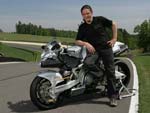
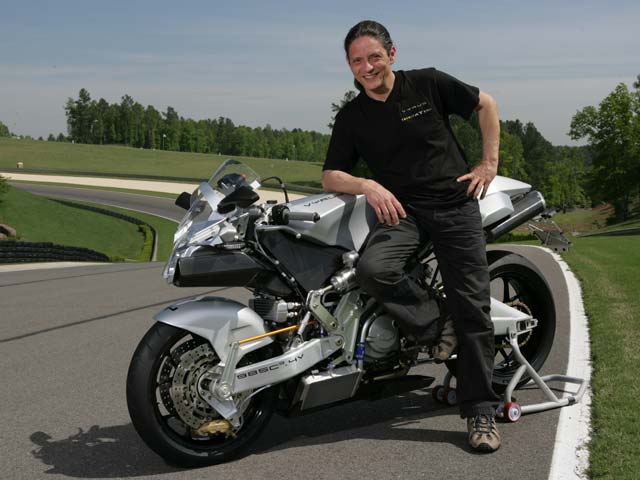
Ascanio Rodorigo and his Vyrus 985
ARP already had some pretty effective after-hours
helpers, not least Dervis Macrelli, the frame-making
wizard who's worked with Tamburini putting his ideas into
metal ever since the early Bimota days, and who got into
the habit of stopping by ARP after clocking off at CRC (Cagiva
Research Center) to help create what became known as the
Vyrus. Where'd that somewhat, er, negative-sounding name
come from, then? "When considering how the first
prototype should be, we decided to build a bike to
display at the Padova Show the following January, which
is the Mecca for anyone doing something special on two
wheels in Italy," explains Rodorigo. "It was a real
challenge that meant we worked day and night for three
months. One night at 3 a.m., I was washing my hands free
of powder after working on the body styling-we didn't
have 3D computer modeling, we did everything by hand
according to a rough drawing, just by eye. My friend
Mauro working with me was a builder during the day, and
he kept trying to persuade me to go to bed-so he could
too, I guess! But I wanted to get the body finished-then
when we'd done so I suddenly realized we hadn't got a
name for the bike. We couldn't call it Tesi, because that
was Bimota's name-but then Mauro told me, we must call it
Vyrus, but with a `y' not an `i', because this is not
like the one before, a virus that is in every computer
and maybe in us, too, to be so crazy working here at 3
a.m. to build a motorcycle. So, that's when ARP became
Vyrus."
That first Vyrus 984 duly made its debut at the Padova
Show in January 2003, powered by a tuned Ducati 900SS
desmodue motor of the kind ARP had been racing with
success in SuperTwins events-hence the model designation,
which was the cubic capacity of the engine. "We knew this
engine very well from racing it, so it had no secrets
from us," states Rodorigo. "If we were to concentrate on
trying to make this high-tech chassis design work
properly, we had to not worry at all about the engine, so
that's why we chose the desmodue. It was a known quantity."
But the proprietor of the new Vyrus company admits to
being completely unprepared for the rapturous reception
his new bike received. "We had literally hundreds of
inquiries to make production versions of our prototype,
which we were quite unprepared to do," he says. "But I
realized we had now to turn the prototype into a customer
version we could manufacture in series in small batches,
always by hand, but in some kind of volume. We had to get
the bike homologated first, though, which in fact was a
fascinating experience I enjoyed very much, producing the
lightest twin-cylinder sportbike in the marketplace,
though always completely street-legal-but finally we
succeeded."
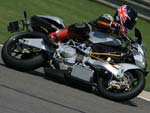
Alan Cathcart on the Vyrus at Barber Motorsports Park
After an intensive development process on the
racetrack, during which the Vyrus 984 Pro Twins racer
became a regular visitor to the rostrum in European
twin-cylinder racing in the hands of Gianluca Villa,
nephew of the late four-time world champion Walter, the
first fully homologated Vyrus streetbike met its happy
customer in January 2003. Since then, a total of 70 such
bikes have been constructed, 25 of them marketed in a
neat squaring of the circle under the Tesi 2D tag by the
born-again Bimota company through their dealers around
the world-including two bikes sold in Russia, and 10 to
Japan. With production up and running of this desmodue
version, delivering 77 bhp in a bike weighing 339 pounds
in street-legal form, Rodorigo turned his attention to a
Superbike version powered by Ducati's 104mm-bore 999cc
Testastretta motor, to create a modern version of the
original Tesi which inspired the whole design. After a
strung-out development path beginning back in 2004 ("We
are only five people, and demand for the 984 is so
constant, we couldn't spare the time to pay attention to
the new bike," he shrugs), the first 985 appeared at the
start of this year, and was promptly sold-to Russia!
Since then, two more 4V bikes have been built, of which
the test machine was the first Vyrus to cross the
Atlantic to head up a U.S. sales drive.
The dramatic modernist styling of the Vyrus 985 is the
work of Rodorigo himself, with close help from ex-Ducati
designer Sam Matthews, formerly Pierre Terblanche's
right-hand man, but now working for Citroen in Paris. "We
did this at long distance, with Sam making CAD drawings
and me interpreting them into a full-size clay model,
then e-mailing him photos of the result," says Rodorigo.
A copy of the finished article can be yours in the color
of your choice 60 days after placing an order for 54,750
Euro (about $67,750) inclusive of tax in Italy, with full
EU homologation. A fully-faired option will be available
later this year, at additional cost.-MC